
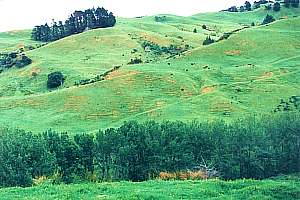
A hill side in northern New Zealand showing creeping erosion. Large sections of soil are slowly creeping downhill, leaving deep cracks behind. Notice the difference in soil management between the farm on left, who uses fertiliser and the one on the right side of the fence, who doesn't.
---------------------------------------------
A hill side near the one on left, showing land clipping where sheep and cattle tread. Clips are small drops of soil, leaving bare soil behind
---------------------------------------------
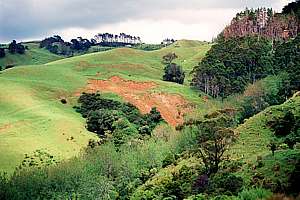
A slip or land slide on a hill side in northern New Zealand. The bare soil left behind is very vulnerable to erosion from raindrop impact and should be fertilised and re-sown, followed by fertiliser maintenance. Seeding alfalfa, which is a leguminous deep-rooting ground cover, resistant to drought, could hasten the soil's recovery.
-----------------------------------------
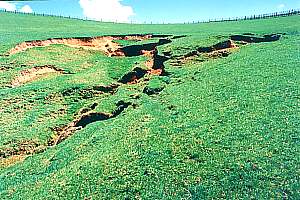
A form of creep caused by tunnelling and subsequent collapse of the underground tunnel. Such erosion forms creeping gullies that are very hard to contain. Planting trees uphill preventively and inside the gully helps to contain it and to minimise erosion by water. Retirement would not necessarily be a remedy
----------------------------------
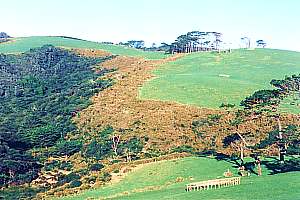
The erodible hillside has been retired from grazing and fenced off. Natural vegetation is allowed to re-establish, pioneered by the leguminous and prickly gorse. Gorse is considered a pest because it infests poor farmland and is hard to eradicate. But for hillslopes like these, it brings natural nitrogen fertiliser, while preparing the soil for the native bush (on left
-------------------------------------------
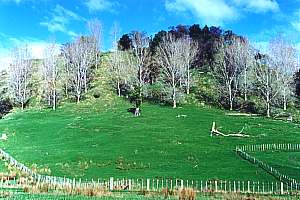
A hillside preventively planted in poplar trees, widely spaced in order to let light through. Trees anchor the soil, cycle deep nutrients and provide decomposing litter to feed the soil. Fallen branches and stems slow down sheet wash. Leaf litter covers the soil against raindrop damage. Stems and branches can be used in gullies to stem the flow of water
-----------------------------------
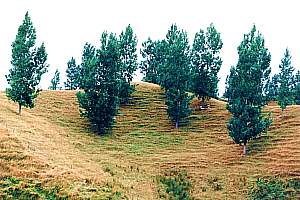
A hill side is preventively planted in widely spaced poplar trees. These trees bring many advantages and may make a decisive difference in the sustainability of this grassland. The trees are not intended to be harvested, but need occasional maintenance
------------------------------------------------------
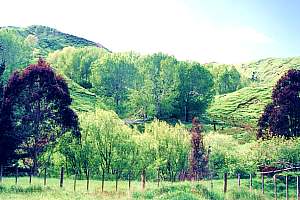
To overcome gully erosion and land slides, the gullies have been planted with poplar trees in dense formation. Poplar trees can be planted as tall posts, reaching over cattle and sheep, so the area does not need to be fenced off.
----------------------------------
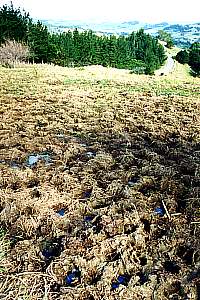
Particularly where grazing animals camp, the ground becomes compacted and waterlogged, a process called pugging. Pugs with standing water in them, are the result. The soil is bared, and exposed to raindrop impact damage
----------------------------------------
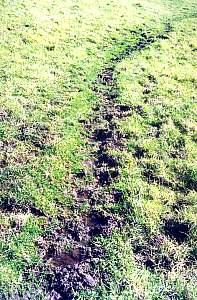
Where animals tramp on their accustomed patterns of movement, the soil becomes compacted and pugged. Particularly on dairy farms where the cows walk to and from the milking shed twice daily, this can be a problem. Paving sensitive pathways, helps to protect the soil from eroding
-----------------------------------------
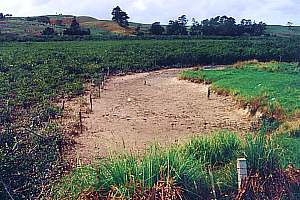
The riparian fence in this picture was not placed to protect a river bank but to protect a stand of mangrove trees in northern New Zealand. As can be seen, these plants disappeared where cattle grazed.
---------------------------------------
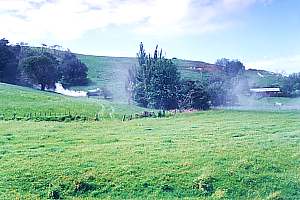
A four-wheel drive truck topdressing pasture in New Zealand. This farm is accessible by four-wheel drive vehicle, but even then, a suitable day must be picked, with little wind and the soil dry enough. Steeper farms are topdressed by plane
-----------------------------------
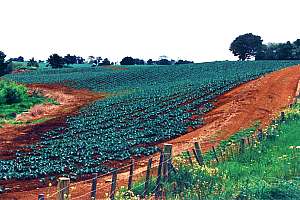
A cropland near Bombay, New Zealand, is not being ploughed along height contours, inviting disaster. Farmers often plough this way to prevent waterlogging; water trapped between furrows. The methods used also leave far too much soil bare
------------------------------------------
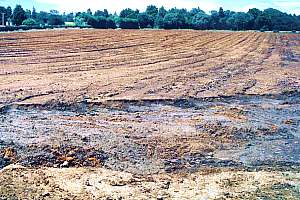
Not far from the place on left, this cropland was severely damaged by rain. It was courting disaster by not contour-ploughing, and allowing such a long water course (field length down-hill). Estimated loss: 10% of the top soil in one rain storm! Notice how rilling starts already high up the field
---------------------------------------
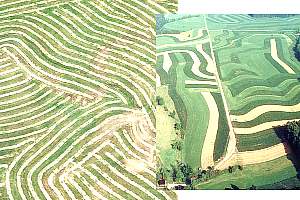
Fields take on bizarre patterns when ploughed along height contours. But it reduces erosion considerably. The picture shows how the land is cropped in strips, each with its own crop and seasonal timing
---------------------------------------------
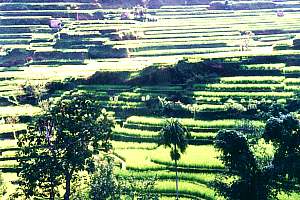
In the humid tropics, padi culture has proved its sustainability. The terraces contour the land, forming perfectly horizontal cropland, which harvests its own water. Padis make their own nitrogen fertiliser with the help of Azolla ferns
--------------------------------------------
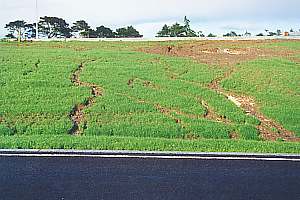
An example of erosion rilling in loose topsoil on a highway bank. Note how the young grass roots were insufficient to stop it, neither was the cover of hay that preceded sowing. See the chapter on roading and roadside management
-------------------------------------
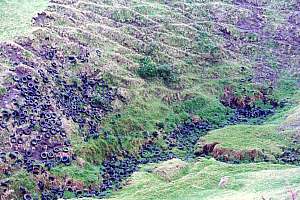
This farmer attempts to control erosion with the help of thousands of old car tyres; in the gully to prevent gully scouring and also on the sandy slopes. Rather than introducing an element of pollution, it would be much better to fight erosion by natural means. Besides, trees would have achieved much more. But the point here is that these hills should never have been grazed in the first place, and retirement is now the best remedy
------------------------------------------
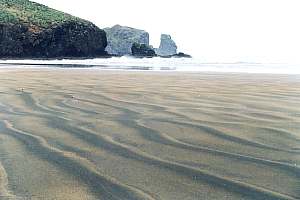
In heavy wind, the sand is seen saltating away from the photographer, as a fast moving sheet, weaving ripples as it goes. The darker sand, which contains heavier particles and magnetite, stays put underneath, as the light-coloured sand moves over it
---------------------------------
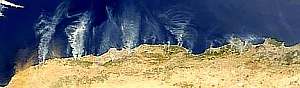
This satellite image captured smoke and dust blowing from northern Africa over the Mediterranean Sea. The white plumes are smoke, the brown plumes on left are dust. Burning is still a common practice, particularly in arid areas. It is done to prepare soil for planting, but precious nutrients and soil organic matter are lost.
(Image courtesy NASA)
------------------------------
 Figure WM.10 Rain drop impact causing splash erosion (Image courtesy NRCS)
 Figure WM.11 Severe sheet erosion on a field (Image courtesy NRCS)
 Figure WN.12 NRCS personnel inspecting rill erosion on a field (Image courtesy NRCS)
 Figure WN.13 Severe gully erosion on a field in Iowa (Image courtesy NRCS)


