Basic erosion
Basic erosion
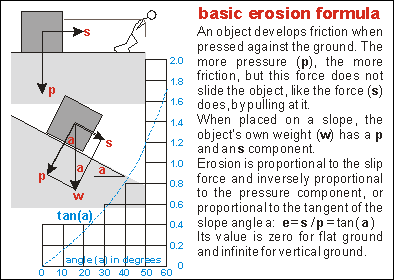
The diagram gives an idea how erosion derives from gravity. In the top diagram, a man is pulling an object over the flat ground. Had there been no pressure of the object pushing on the ground, there would have been no resistance or friction. Friction not only depends on this pressure but also on the properties of the two materials: object and ground. In the case of soil and its particles, this is not relevant, but a stone on a gravel bed would slide less easily than a stone on a wet mud slide. When placed on a slope, the weight of the object develops both a pressure and a slip component (second figure). Since soil erosion is proportional to the downward pull s, but inversely proportional to the friction, thus pressure p, it follows the tangent of the slope, as plotted in the graph with a blue dotted line.
Erosion rapidly takes off as the slope of the land increases. For small angles it is proportional to the slope, but for steeper land it increases rapidly to infinity. Note however, that this formula does not take into account the erosion caused by the flow of water, or that of raindrop impact.
Source: Floor Anthoni, 2001.