Gravity and compaction
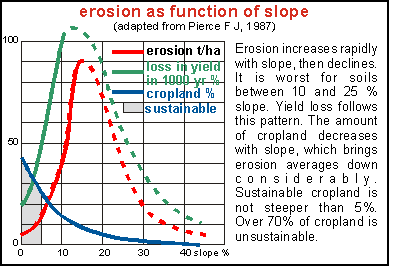 Because of the enormous variability in field data, soil losses are difficult to quantify. The graph on the right shows how crop land erosion increases with slope. Flat land is very stable (losing 2-5 times natural replenishment!) but soil losses increase rapidly with land sloping 2-5%. Land with a 10% slope has 8 times higher erosion, which makes it impossible to farm by ploughing, but perennial crops may be sustainable. At 15% slope, soil erosion has doubled again. But slopes over 20% appear to be less affected, and the reasons for this could be that they are higher uphill, less prone to receive the water from a field higher up, and the run from hillcrest to valley floor is shorter. Their fields are shorter too.
As can be expected, the loss in productivity follows the erosion curve, reducing flat land by 18% in a millennium (!?) and climbing to 100% for slopes of 10%. Fortunately, the amount of steep cropland is much less than flat cropland (blue line), but in sufficient quantity to worry about. Although the graphs are rather puzzling, the main message they bring is that soil slope has a considerable, and unintuitively large effect on erosion.
As far as sustainability is concerned, any land steeper than 5% should not be ploughed, but returned to perennial crops like viticulture, horticulture or grassland. Slopes above 10% for trees. If it is accepted that only land sloping less than 5 degrees can be cropped sustainably, then over 70% of arable cropland appears unsustainable.