|
Wind
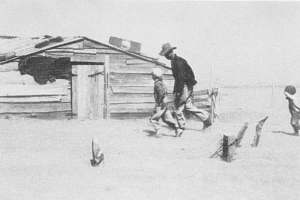 Memories don't last forever. They disappear when one dies, reason why people are doomed to repeat the mistakes of their grandparents (3 generations = about 90 years). How many people today would remember the days of the dust bowl? This famous photograph in all its sadness, reminds us of an event in the history of agriculture in America, that is remembered for its unavoidability and its sadness. A farmer and his two sons are seeking shelter from the arriving dust storm. A derelict shed speaks of extreme hardship. Nothing on their land is like it was only a few years before. Memories don't last forever. They disappear when one dies, reason why people are doomed to repeat the mistakes of their grandparents (3 generations = about 90 years). How many people today would remember the days of the dust bowl? This famous photograph in all its sadness, reminds us of an event in the history of agriculture in America, that is remembered for its unavoidability and its sadness. A farmer and his two sons are seeking shelter from the arriving dust storm. A derelict shed speaks of extreme hardship. Nothing on their land is like it was only a few years before.
It happened when a period with prosperity and adequate rainfall, was followed by an unexpected one of continuous droughts. The farming practices which were once appropriate, suddenly became disastrous. With their lands bared, farmers were caught out by the drought, unable to do anything meaningful. The winds did the rest. Sadness followed. |
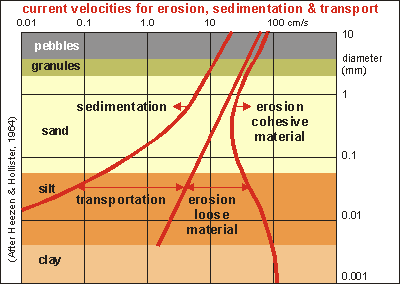
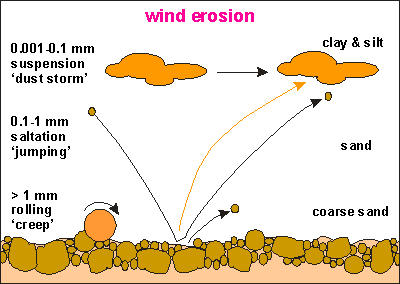 Just like moving water being able to move soil, moving air can do so too. In fact in the same way as the curves of the erosion/sedimentation diagram above (soil51.gif). Fine particles are moved easily (but not when wet) and when they are as small as clay and silt, they become airborne, reluctant to settle out again, even though air is 800 times lighter than water. Sand particles between 0.1 and 1 mm move by saltating (jumping) over the ground, like a sheet. Heavier particles move by rolling.
Unlike water, wind can move soil over very large distances of thousands of kilometres and over sea to other countries. It can move soil up-hill. Of course, the finest clay particles are transported furthest. The amount of soil moved, must not be underestimated, and once in motion, and the air heavy with dust, its erosive power increases. At least rain runs in gullies, but the wind blows everywhere. In many countries, usually those with arid climates, erosion from wind is considered by far the worst.
Damage is caused in various ways:
-
loss of fine soil: fine soil is transported furthest away. The fine clay particles bind nutrients and are crucial to fertility.
-
loss of crops: crops are lost because they are being dug out, sand-blasted and covered in soil.
-
damage to soil: the composition of the soil changes; the land is furrowed in rills and gullies, leaving infertile rock behind.
-
damage to buildings and infrastructure: roads are dug out and sand deposited over houses, fences and so on. The farm becomes unrecognisable.
|
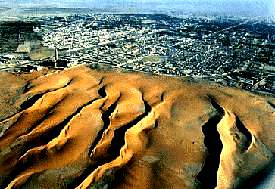 To avoid wind-blown erosion, arid soils should not be worked, but in order to survive, people do. The remains of the previous crop (stubble, stalks, straw) should not be removed until just prior to planting. Strip cropping shelters the land and so do shelterbelts. Reduced tillage or no-tillage is preferable. Once the soil has been swept into land dunes (as opposed to sea dunes), these should be planted and stabilised. Fertiliser is an important weapon in doing so. To avoid wind-blown erosion, arid soils should not be worked, but in order to survive, people do. The remains of the previous crop (stubble, stalks, straw) should not be removed until just prior to planting. Strip cropping shelters the land and so do shelterbelts. Reduced tillage or no-tillage is preferable. Once the soil has been swept into land dunes (as opposed to sea dunes), these should be planted and stabilised. Fertiliser is an important weapon in doing so.
(The photo shows the linear dunes of the Sahara Desert encroaching on Nouakchott, the capital of Mauritania. Note how massive and unstoppable sand blowing can be. Photo by Georg Gerster, courtesy U.S. Geological Survey)
|